Thursday, August 16, 2007

Process: Tshesele High School Route

Date: 03 August 2006
Route Guide: Antonette Sithole (June 16 Foundation)
Documenter: Ismail Farouk and S'phelele Nxumalo (ASM)
Observer: Oupa Moloto (June 16 Foundation)

On Thursday 3rd August 2006, Our research group began to map the route taken by Antonette Sithole on June 16 1976 from Tshesele High School in Central Western Jabavu to Phefeni Junior Secondary in Orlando West. Sithole is Hector Pieterson's older sister. Today she works for the June 16 Foundation which is located within the Hector Pieterson Museum.
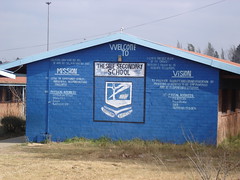
Thesele High School
Figure: Tshesele High School

At the beginning point, within the Tshesele school grounds, Sithole described how students from the nearby Morris Isaacson High School came to her school to collect students in their united march against the oppressive system. Sithole said, “We were very happy with pride, we were looking forward to uniting with other schools. It was the first time that students were without parents and so very happy. No one told us what to do and we were happy to miss school. Singing and chanting…we were told to be calm and not to provoke the police…We planned to walk on the main street but took short cuts to avoid police”.

We left the school grounds and walked in a northerly direction on Diokane Street. I asked Sithole how her brother Hector got involved in the march, to which she replied, “The younger one's saw us leaving in our uniforms and wanted to join the excitement".

We turned right off Diokane Street, into Mavi Street and left into Mlangeni Street and proceeded west towards Mputhi Street. At this point, Tshesele High students joined the main group from Morris Isaacson High School. Today a general dealer called Sizwe Stores is located at this meeting point. In 1976, there was a coal yard on the site. Oupa Moloto commented that there were about 2000 students in the group outside the coal yard.

From this point, Sithole directed us north on Mputhi Street past the Mshenguville Squatter camp. We soon turned right onto Mwasi Street and proceeded through Mofolo Park on Mzilkatzi Street.
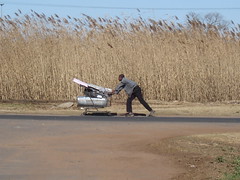
Trolley Pusher Mofolo


Figure: Trolley Pusher on Mzilkatzi Street.

We turned right into Mptipa Street and stopped outside the home of Dr. Nthato Motlana. Dr. Motlana devoted his live to serving the community of Soweto. He was the founder of the Black Medical Discussion Group in the late sixties to raise funds for struggling medical students and was involved in many other community organisations (Mashabela 1987). It was here outside the home of Dr. Motlana where Tsietsie Mashinini addressed students warning them about a police presence and calling for calm.

I asked Moloto how Tsietsie got to this point as he had just addressed another group of students at the landmark bridge on Machaba Street. Moloto explained that unmarked vehicles were used by the coordinators of the march on the day. He suggested that the vehicles were hired by members of the ANC. Tsietsie was driven around and was therefore able to address various groupings of students at various stages of the march.

The route meandered along Mtipa Street and we soon turned uphill on Butshingi Street. At the top of Butshingi we turned right into Vilikazi Street. Further on Vilikazi Street we stopped at the official shooting site of Hector Pieterson on the corner of Vilikazi and Moema Streets. The memorial is often vandalised by youth who express themselves through graffiti.
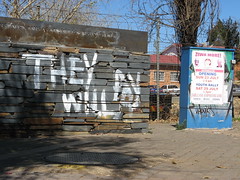
They Will Pay
Figure: The Memorialised Shooting Site

According to Sithole, the location of the official shooting site differs from the actual spot where her brother was shot. She remembers the shooting site being closer to the corner of Moema and Phiri Streets where she was hiding in the yard of the corner house.
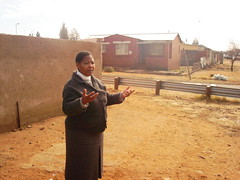
Antonette Sithole
Figure: Antonette Sithole relives the events of June 16 1976.

I asked Sithole what happened here once she got here? Sithole relates: "When the shooting began, I went into hiding. When the shooting stopped, I came out of hiding when others came out. I saw Hector across the street, and I called him and waved at him, he came over and I spoke to him but more shots rang out and I went into hiding again. I thought he followed me but he did not come. I came out of hiding and waited at the spot where I just saw him but he did not come. When Mbuyiso came passed me a group of children were gathering nearby. He walked towards the group and picked up a body...And then I saw Hector's shoes".
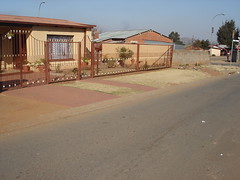
Famous Photo Site
Figure: The Famous Photo Site

A short time later Sithole was running beside Mbuyiso who was carrying Hector Pieterson. They headed towards Phomolong Clinic along Sisulu Street. Along the way, a photographer called Sam Nzima took the famous picture of the distressed children.

Whilst at the clinic Sithole watched a frenzied mob kill a white municipal worker who was later identified as J.N.B. Estherhuizen. He was dragged from his car and brutally killed. Estherhuizen was one of two white officials killed on the day.
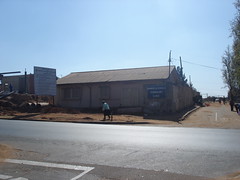
phomolong cliinic
Figure: Phomolong Clinic

Hector Pieterson was pronounced dead here at Phomolong Clinic. Today, Sithole continues to keep her brother's memory alive with her work at the museum and as a public speaker. When not in the museum, she can be found on the streets of Soweto, physically laying the bricks on the the route taken by students on June 16 1976.


Process: Mapping The Naledi High School Route

Date: 22 August 2006
Route Guide: Patrick Lephunya, Regional Director of Soweto
Facilitator: Ali Hlongwane (Curator HPMM)
Documenter: Ismail Farouk
Observers: Oupa Molota (June 16 Foundation),
Angel David Nieves, PHD. (Director Graduate Research & Training, Consortium on Race, Gender, and Ethnicity at Maryland University)

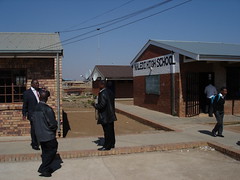
On the 22nd of August 2006, our research team retraced the Naledi High School Route under the direction of Patrick Lephunya, the regional director of Soweto.We began our journey at the school where Lephunya described the events of the morning of June 16, “At assembly the principal NJK Molope came in and wanted to sing a hymn but students stood up and shouted out, ‘Amandla!’ and sang ‘Nkosi Sikelele Afrika’ instead. The students unfurled banners and plackards before heading off into the streets”.

Naledi High School
Figure: Patrick Lephunya (left) describes the morning's events at Naledi High School

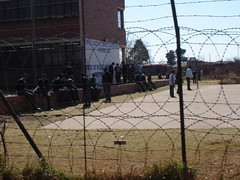
Lephunya showed us the telephone lines outside the principal’s office which were cut in order to prohibit any calls to the police. Earlier, on the 9th June, two policeman came onto the school grounds to arrest a student. The student in question, Enos Ngutshane was wanted for questioning.
The principal came into our classroom and said, ‘hey, mmona (man) it looks like you are in trouble the police are here and they would like to go with you’. Then he went back to his office and continued the discussion with the police just to find out what is happening, “I took my bag instead of going to the principal’s office I went to the classrooms where the members of the South African Student Movement (SASM) were and said, ‘guys I’m in trouble the police are here to arrest me’. So there was a quick discussion and the guys said, ‘you know what don’t go to the office, you go back to your classroom and give us 10 minutes [Laughs]’. So I was looking at my watch exactly 10 minutes the bell went. But it was not natural; it wasn’t supposed to be ringing at that time. But they had done their work. They had already moved into all the classrooms to say the bell is going to ring and all of us must be at the assembly. So we went to the assembly and students were in one voice ‘you are not going anywhere’.
Later, Ngutshane walked in the principal’s office and said ‘this is the situation it looks like nobody is going to leave the school, including myself [Laughs]’. So there was pandemonium in the principal’s office. As the three of us were still talking, the white policeman, the principal and myself, the other police guy came in and said, ‘hey, the car is now on fire outside [Laughs].
The police car was destroyed, burnt and overturned. Unfortunately the students did not cut the telephone line on time and police reinforcements soon arrived.

(Extract from an interview with Enos Ngutshane)


After, a brief inspection of the school grounds, and the memorial to those who lost their lives in a bus tragedy in Mozambique in 1974, our group set off in a hired mini bus.

Contrary to popular belief, the Naledi High School Route does not make a beeline to Morris Isaacson School as illustrated by the proposed paving route on the Johannesburg Roads Agency map., The Naledi route remains highly contested. However, the initial stages of the route shown to us by Lephunya, is corroborated by Harry Mashabela in his book, “A People on the Boil”. The book contains a very detailed description of the initial stages of the Naledi High School Route.

Batswana High School
Figure: Batswana High School

Our first destination was Batswana Junior Secondary School, which is located close to Naledi High School in a South Eastern direction. Today, Batswana Junior Secondary School is known as Thabo Secondary School. Lephunya described how students from the school gathered at the small gate as they waited for the Naledi group to arrive before heading off to Thomas Mofolo High School.

Thomas Mofolo High School
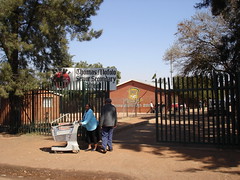
Figure: Thomas Mofolo High School

At Thomas Mofolo Senior Secondary School, a further 500 students waited to merge with the Naledi group. Our journey continued down Mpetslane Street where Lephunya pointed his mother’s house out. On the morning of the march Lephunya stopped here to drop his school books off before continuing with the march. He also added that there were no incidents at this point of the march.

Tdladi Secondary School
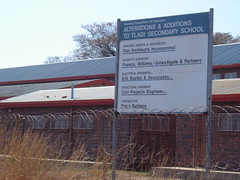
Figure: Tladi Secondary School

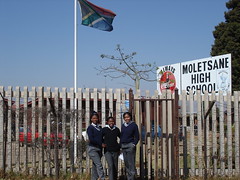
Lephunya directed the minibus right and then left onto Legwale Street before turning left onto Thamagane Street where more students from Tladi Secondary School joined the march. We meandered through tiny unnamed residential streets, and a few sharp turns later we found ourselves back on the main road, Masiane Street. Our next stop was Moletsane High School where students asked us to photograph them in front of the school. We continued on Masiane Street and turned right into Mphahlele Street where we stopped outside Mphahlele High School.

Moletsane High School
Figure: Moletsane High School

The next part of the route is where the greatest contestation lies. The plan on the day was to merge with students from Morris Isaacson High School and this is supported by Harry Mashabela’s book, which describes the scene when the Naledi group arrived at Morris Isaacson High School to find the school deserted with a sign at the gate which read, “No SB’s – Trespassers Beware!”. Lephunya’s route, however, does not include Morris Isaacson High School, rather it meanders through the ‘big circle’, at Letabe Street in Central Western Jabavu, east of Morris Isaacson High.

An explanation for the contestation can be found in the fact that not all students followed the same path. While the majority of students may have taken the path described by Lephunya, it is possible that some students from Naledi walked along Makapan Street before turning right into Mputhi Street towards Morris Isaacson High School. This possibility can be explained by the testimony of Solly Mpshe in the book “June 16 1976” by Brink and Malungane (2001). Mpshe was a student at Morris Isaacson High School. He relates being forced out of his class and being forced to march despite not knowing what was going on. He says that this occurred during the second period around 09.30am and places responsibility for being forced into marching on students from Naledi High School (Brink and Malungane 2001:39).

Lephunya’s route continued on Letabe Street in a northerly direction until the street changes name to the Moroko Nancefield Road. We turned left into Mncube Street and continued westwards towards Mahalefele Street. We turned right on Mahalefele Street but instead of turning towards Vilikazi Street, the end point for many other school routes, we continued down towards the Klipspruit River close to the point where Hastings Ndlovu was killed.

Hastings Ndlovu Shooting Site
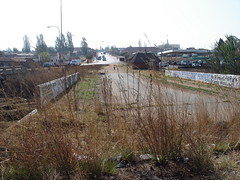
Figure: Hastings Ndlovu Shooting Site

We stopped just before the bridge on Kumalo Street. On the other side of the bridge is where police were reported to have congregated. Lephunya’s version of the Naledi High School route ends here.

Sources:

1. Brink, E. and Malungane, G. (2001): Soweto 16 June 1976, Personal accounts of the Uprisings, Kwela Books, Cape Town.
2. Mashabela, H. (1987): A People on the Boil, Reflections on Soweto, Skotaville, Publishers, Johannesburg and Cape Town.


Sunday, July 15, 2007

The Events Leading To The Uprisings

In 1974, the Director of Bantu Education in the Southern Transvaal (Mr Ackerman) issued a directive compelling school boards and principals of schools to use Afrikaans as the primary means of instruction. This directive followed an earlier imposition which divided school boards along ethnic lines. This ethnic division ensured that African children from the various ethnic groups would no longer be educated in the same classroom.

Previously, the choice between English and Afrikaans had rested in the hands of the community. With the freedom of choice taken away and with the enforcement of Afrikaans, parents, principals and the tribal school boards were naturally distraught. They saw the injunction as politically motivated and appealed to Ackerman to withdraw his ruling, but he remained unmoved.

The school boards in Soweto combined forces in August 1975 and formed the Federal Council of Transvaal School Boards, in order to deal with the language imposition with one voice. However, resistance to the Afrikaans directive was met with harsh consequences. In February 1976, Ackerman’s board fired members of the Tswana School Board for being too stubborn. Other members of the board resigned and parents of the represented school children supported them in their actions.

A crisis in education had developed. Disillusioned youth had watched their parents and teachers fail in attempts to reverse the Afrikaans instruction directive. On May 17th, students from Phefeni Junior Secondary School refused the imposition of Afrikaans instruction and began a boycott of classes. The students demanded to see the circuit inspector of African schools, M C de Beer. When he refused to meet with them, the students turned to violent action by first damaging the principal’s car and then stoning his office. De Beer reacted by threatening to expel the students but they continued their boycott of classes with the support of four other schools in Soweto.

Students were far more radical than their moderate parents. “Our parents are prepared to suffer under the white man’s rule. They have been living for years under these laws and have become immune to them. But we strongly refuse to swallow an education system that is designed to make us slaves in the country of our birth”, wrote a student in a letter to The World newspaper. (Hopkins and Grange 2001)

On June 9 1976, two policemen drove into Naledi High School to arrest a student for questioning. The principal warned them not to do so in the presence of other students. The policeman were confronted by angry students and needed to lock themselves in the principal’s office in order to escape the angry mob of students. Whilst in the principal’s office, the students set the police car alight.

It was around this period, with the banning of the ANC and the PAC, that a political vacuum was created. Leaders of both organizations were subsequently detained. Any political activity which lingered after the Sharpeville massacre ended with the Rivonia Treason Trail and subsequent life long jailing of Nelson Mandela, the ANC President along with others. Black Consciousness was born out of this political vacuum. The Cillie Commission found that the immediate cause of the riots related to the policy on language instruction at school but this was only one of the causes. Other grounds for dissatisfaction included:
  • The black consciousness movement (Cillie:601);
  • Political and military events in South Africa
  • The homelands policy
  • Influx control
  • Actions of the Administration Boards
  • UBC
  • Lack of citizenship related to the homelands policy

Sources:

  1. The Cillie Commission, (1980): Report of the Commission of Inquiry into the riots at Soweto and other places in the Republic of South Africa during June 1976. Also: Unpublished minutes of evidence Volumes 1-69.
  2. Mashabela, H. (1987): A People on the Boil, Reflections on Soweto, Skotaville, Publishers, Johannesburg and Cape Town.
  3. Hopkins, P. and Helen G. (2001): The Rocky Rioter Teargas Show: The Inside Story of the 1976 Soweto Uprising, Cape Town, Zebra Publishers.


Tuesday, July 10, 2007

Robert Berold's Story: Morris Isaacson High School

Robert Berold was a white english teacher at Morris Isaacson School in 1976. On June 16th his life was saved by an unknown student. Here is his story:

I was driving in my yellow Peugeot 404 bakkie which was our wedding present a few months ago. It was a cold sunny Wednesday. On the seat was a tape player with the Fairport Convention singing their version of "Sir Patrick Spens":

I saw the new moon late yestreen
with the old moon in her arms

I was teaching (illegally) in Soweto. Sir Patrick Spens was one of our matric poems.

For weeks the tension had been getting tighter and tighter. Dr Andries Treunicht the ex-dominee who headed the Department of Bantu Education had decided that schools – some schools anyway – were to be taught in the medium of Afrikaans. That meant all subjects – geography, maths, whatever – would be taught in Afrikaans. A provocative and crazy idea. Treurnicht knew that black students were weak in Afrikaans, in fact hated Afrikaans, the language of the oppressor. So why was he doing this? Sheer shit-headedness, the racist drive to be as shit to blacks as possible. The parents had formed a committee and gone to see the minister, but Treurnicht was not backing down. The deadline was next week.

Every morning I drove from our communal house in Houghton, onto the M1 South into Booysens, onto the no-man's-land road to Soweto, Diepkloof, left past Orlando Stadium, past the very first red brick houses, past the Orlando police station with its blue light and twitching radio masts, over the bridge to Phefeni, up to Maponya's store, down through the pleasant trees of Mofolo village, into the sea of asbestos roofs of White City Jabavu, up the hill and left into the Morris Isaacson Senior Secondary School yard enclosed in scraggly wire.

This morning no students were to be seen. Fanyano Mazibuko, the maths teacher, was driving out in his white VW beetle. 'The students have all gone out on a march' he said, 'I'm going to look for them.' It didn't look like Patrick Spens would get a hearing today.

I'd joined Morris Isaacson because I wanted to be in a black environment, which was a hard thing to do in the 1970s and usually illegal. For various reasons or delusions I trusted black people more than whites. When I came here I offered to teach maths but Mathebathe the headmaster said 'We need you to teach English, it's your home language, we can learn from you'. So here I was, my first teaching job, unqualified to teach, with huge classes, 50 or more kids, getting to grips with a ridiculous rote-learning syllabus. Silly textbooks, lists of comparisons, of idioms, all had to be learned off by heart. As white as snow, as black as pitch. As fast as a stolen car, one student wrote.

I had literary ambitions for them. I'd started a class library, got them to read books, introduced them to contemporary black poetry. They didn't feel the same way, they just wanted to get through their exams. They were curious about me, though, and once they'd established that I was too naive to be a police spy, they were friendly. Occasionally the daring guys from the Black Consciousness Movement would come to the school. The whole school would walk out of class for an hour while they addressed them. South Africa was going to be free, they said. Black man, you are on your own. Then they would disappear before the police could catch them.

For the past week, as the tension had been rising, posters had been going up 'YESTERDAY MOZAMBIQUE TODAY ZIMBABWE TOMORROW AZANIA'
'AFRIKAANS -- LANGUAGE OF THE OPPRESSOR'

And now today the whole school had gone off before assembly, marching to Naledi High. Nobody knew about it, not even the teachers. As I heard about it later, they were picking up each school and marching to the next one. The headmaster came and told the bored staff to stay in the staffroom. The students would be back soon, he said.

A few hours passed. The staff room was large and dark. Outside it was a bright winter morning. I was reading a library book, a Time-Life book on the religions of the world. Buddhist monks with shaved heads in yellow robes were praying in a temple somewhere in Asia. Then a boy burst into the room, running, very distressed. The students had been blocked by the police at the Orlando Bridge. They'd been shot at, and some students had been shot dead. And now they were on the rampage, burning buildings and cars.

We rushed outside. From the direction of Orlando, there were plumes of smoke rising. What now? Stay put, said the headmaster. More students arrived, out of breath, frightened, angry. Some of them had looted a liquor van and brought bottles of booze for the staff. Some of the male teachers started drinking voraciously.

I went outside again. The plumes of smoke were closer now. Not far away, in Jabavu, a building was burning, I could see the flames. Students were running in the streets. A white man was driving a municipality van, swaying from side to side down the road. His windscreen had been smashed and his face was bleeding. Boys threw rocks, they hit the car, but he carried on driving, bleeding.

Next thing the school was swarming with students, angry, running, like an ants nest that had been turned over. Some of them saw me, one of them shouted Hey Mr Berold, you'd better hide, these students have killed whites they will kill you! The same boy took me to the book room, a big walk-in room with a security door where the textbooks were stored. He told one of the teachers – you must lock him in here until the other students have gone. I stood in the bookroom listening to angry voices, slogans being shouted.

The students went off, running, and I was allowed out. Back in the staffroom, some of the teachers were now completely drunk from all the free booze. A building quite near the school was burning. We sat there in the semi-dark. How will I get out, in my brand new yellow car? We can take you in the boot of one of our cars, says one of the teachers.

The door burst open again. A scary sight – about 20 white soldiers in camouflage uniform. Or maybe they're policemen. They’re wild-eyed. All of them have sten guns. They glare at the black teachers like I've been taken prisoner. Their commander is dressed in a purple suit. 'Who are you?' he says to me. 'I work here' 'You better come with us'. I say goodbye to the teachers, feeling ashamed of being white, being claimed by these men with guns. Outside in the road there is a column of vehicles, an armoured car in the front and one behind. It's a convoy rescuing stranded whites. The street is lined with silent people, some of them my students. The police keep pointing their gun at the crowd, some of which scatters. The convoy moves slowly. I look at the angry mournful eyes. At one point the convoy stops, the police jump out angrily, students run madly across the veld, away from the guns.

Next thing I am in Booysens again, the busy everyday traffic of industrial downtown Johannesburg. The human storm hasn't reached here. Nobody yet knows what is happening in Soweto, not even the parents of the children who've been shot at.

I drive home with my tape recorder and Sir Patrick Spens. I don't know what to do or say. I lie down on the lawn of our communal house and try to think. There is nothing to think. I hear a loud noise overhead like a giant lawnmower, three army helicopters travelling southwest. I know where they're going. To Soweto. It's a chilling feeling.

That evening I go over to my parents' house. TV has just started up in South Africa. The only good programme, which I watch with them every Wednesday, is about the Second World War, called The World at War. Before that, the news. Some disturbance in Soweto. Nothing about children getting killed.

Over the next three days, 300 people died in Soweto, as children set up roadblocks, ignored their parents, and fought police with stones and petrol bombs. Morris Isaacson didn't open for classes for another two years. I wrote later, in a poem

I was lucky
the winds of blood blew past me

I wish I knew the name of the boy who locked me in the bookroom. He saved my life.

The official version of the Soweto Uprisings

Nigel Mandy’s version of the morning of June 16 1976 is based on the findings of the Cillie Commission’s report. He provides justification for the police intervention by questioning the legality of the march. According to Mandy, a 1968 regulation provided that no public meeting or march could be held in Soweto without WRAB’s permission. The Cillie Commission report maintains that police were not aware of the intention of the students to march through the streets. Either way it was their duty to prevent an illegal march. A witness suggested that they should have stopped the students at the school and sent them home. Whether the police would have been successful in such an attempt to prevent the march by thousands of pupils and at the same time to keep the peace, cannot be established with certainty; they were unaware of the intentions and preparations, and therefore no such attempt was made to prevent the march and to keep the peace. As the march advanced a long way by the time police realised what was happening, it was their duty to stop the march and disperse the crowds (Cillie: 106).

Mandy’s version of the confrontation describes how the police convoy stopped about 100 paces from the crowd on Vilikazi Street. Col. Kleingeld shouted for the crowd to stand still. His voice was drowned by the uproar and the sound of stones raining down on his men and vehicles. He did not have a loud hailer and therefore no effective order had been given to the crowd to disperse. (Mandy 1982)

Col. Kleingeld then decided to disperse the crowd with tear gas but only one tear gas canister exploded. This action provoked a rain of stones from the students from all sides. The Colonel fired two warning shots into the air and ordered a baton charge. The baton charge was unsuccessful and two police dogs were killed. (Mandy 1982).

Mandy’s version continues by describing how the outnumbered policemen were encircled by angry students. According to Mandy, the policemen feared for their lives and he justifies the shooting which followed as moderate and controlled, reporting only 2 deaths and 11 injuries during the confrontation. (Mandy 1982:198).

Monday, July 09, 2007

Soweto and the Defiance Campaign


The name Soweto is an acronym for the south-western townships of Johannesburg. The name Soweto was adopted in 1963 after a special committee held a naming competition for the township where hundreds of entries were submitted. Five suggestions were recommended, Soweto, Sawesko, Swestown, Phaphama Villages and Partheid Townships. The name Soweto was already in use before the special committee officially announced that is had been selected (Mandy 1982).

Soweto is a symbol of South Africa’s policy of apartheid, which refused to accept the mixing of races. Urban black people were relegated to a city with two cinemas, two banks and no supermarket. This was to the advantage of white businessmen as blacks were forced shop in Johannesburg CBD.

There were many oppressive laws and measures aimed at repressing black people. The repressive laws laid the foundation for the mass-based defiance campaign intent on liberation. The defiance campaign received support from all sectors of society. This changed perceptions of some members of the ANC with regards to Africanism. Oliver Tambo, Nelson Mandela and Walter Sisulu began to have second thoughts about Africanism and embraced multiculturalism. This was reaffirmed by the Freedom Charter, which was adopted in 1955 in Kliptown, Soweto, to represent the demands of a disenfranchised black community. It was this issue, multiculturalism that led to the breakaway by Zeph Mothopeng and Robert Sobukwe and the forming of the Pan African Congress (PAC) in 1959 (Mashabela 1984).

Thursday, June 07, 2007

We Cannot Continue To Die Like This


A Movie By Babak Fakhamzadeh and Ismail Farouk

Avalon Cemetery is one of the largest cemeteries in South Africa and is the final resting place of many political and cultural activists. The cemetery is about 170ha in size and is managed by the City of Johannesburg’s City Parks division. At the entrance to the cemetery, a memorial with the words, “Never Never Again” inscribed on it pays tribute to those who lost their lives in the Soweto uprisings of 1976.

Avalon Cemetery is facing severe pressure. With the death rate is increasing by 10% per year and more than 200 funerals occurring each weekend, the cemetery is running out of space. Compounding the problem is the Aids pandemic. With more than 6.5 million of the country's 47 million people infected with HIV, demand for space is increasing. Every weekend, convoys of buses carrying mourners bring the Old Potchefstroom Road to a standstill. This has resulted in special traffic marshals being deployed to deal with the traffic congestion every weekend. Cremation is not considered appropriate for most people so City Parks are encouraging families to consider the “second burial” option, where several members of a family are buried in the same grave.

“We Cannot Continue to Die like this” is a short animated movie which responds to the pressures experienced by the cemetery because of the increase of funerals as a direct result of AIDS related deaths. The film frames the dense weekend funeral traffic in relationship to the 1976 memorial located at the entrance of the cemetery. This is done to bring about awareness to the current day struggle our society is experiencing. History is represented by the memorial to fallen heroes of 1976 - history will demand to know where our leaders are now, when this preventable disease continues to kill millions of people.